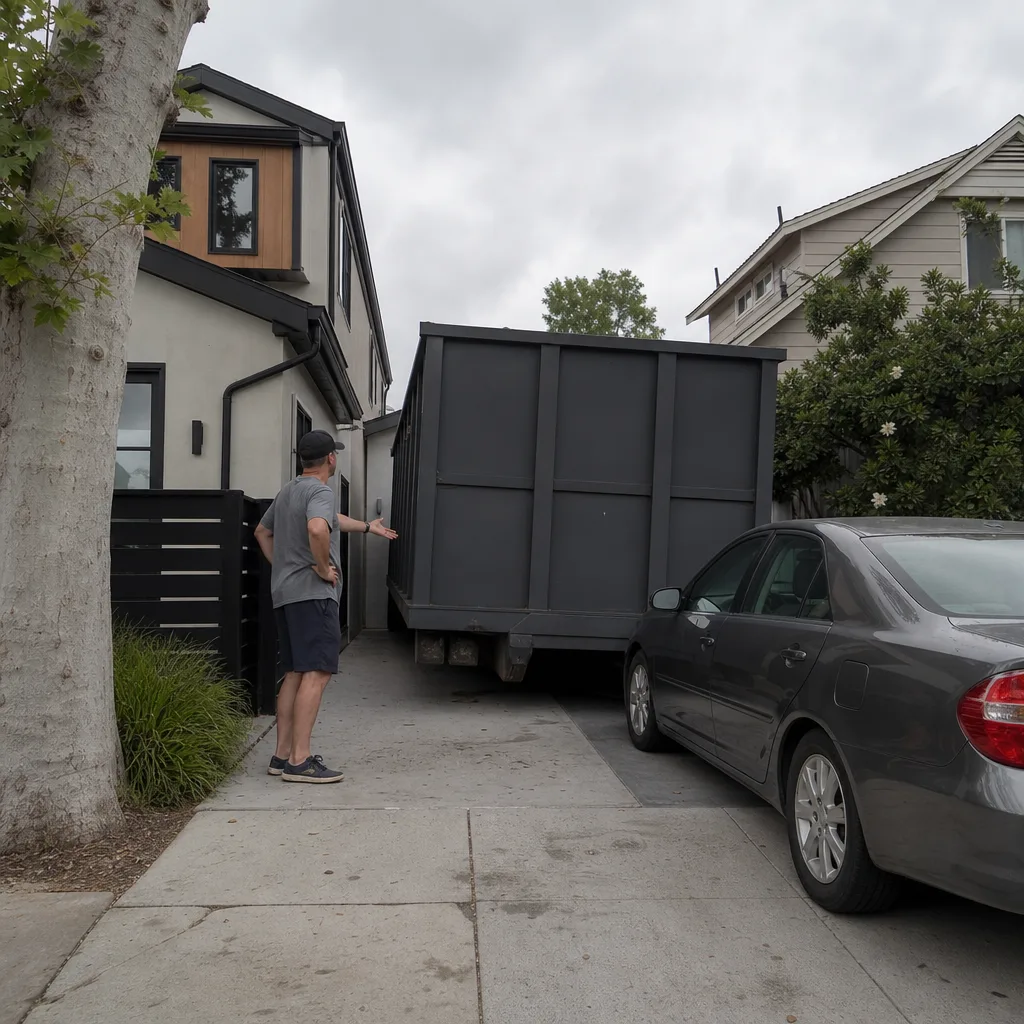
60 Yard Dumpster Dimensions Explained
Let's get right to the numbers. Most 60 yard dumpsters measure about 22 feet long and 8 feet wide. The walls stand around 9 to 10 feet tall. Exact sizes shift a bit from hauler to hauler, but they all stay close to that box.
Why does that matter? Because 60 cubic yards equals about 1,620 cubic feet of space. That's a lot of room.
Picture it this way. Lay the bin next to a standard parking stall and it runs a few feet longer. Stand beside it and the top edge sits well above your head, close to the gutter line on a one-story house. It's roughly the size of a small moving truck's cargo box.
Here's how those dimensions break down in real terms:
- Length of about 22 feet, so it needs more than one standard parking space
- Width of about 8 feet, close to the width of a single-car driveway
- Wall height of 9 to 10 feet, too tall for most people to toss items over by hand
- Total volume near 1,620 cubic feet, or about 18 to 20 pickup truck loads
- A rear swing door on most units, so you can walk or wheel debris inside
That wall height catches people off guard. We see it all the time. A crew starts tossing drywall over the side, then realizes after an hour that they can't reach the top anymore. So they switch to the back door and start stacking from the inside. Smart move, but it's better to plan for it from day one.
Load from the back first. Push heavy, flat stuff to the far end and work your way toward the door, you'll fit a lot more that way.
And the footprint isn't just the bin itself. The roll-off truck needs room to drop it. Figure on about 60 feet of straight, clear space in front of the spot, plus overhead clearance of around 23 feet for the tilt. Low power lines and big street trees can be a problem.
That's a real issue in Santa Monica. Ocean Park has narrow alleys and tight garages. Plenty of lots north of Montana Avenue have mature trees hanging over the driveway. Sunset Park homes often have short driveways that can't fit 22 feet of steel without blocking the sidewalk.
Which brings up placement on the street.
If the bin can't fit on your property, it'll likely land in the street or alley. Santa Monica usually requires city approval for that. But a lot of first-timers skip this step and get hit with problems on delivery day. We check placement before the truck ever rolls out.
One quick scenario. A contractor near the Pico neighborhood ordered this size for a full gut remodel. Great choice on volume. But the only open spot was under a low phone line, so the driver couldn't tilt the bed. A quick site walk the day before moved it 15 feet down the alley. Problem solved. Zero delays.
Not sure your spot can handle a bin this big? Measure it. Length, width, and anything overhead.
What Fits in a Container This Size
Sixty cubic yards sounds like a lot. But what does it really look like?

Start with a pickup truck. A standard truck bed holds about 3 cubic yards of loose junk. So this container swallows roughly 20 full pickup loads in one go. That's 20 trips to the transfer station you don't have to make.
Trash bags help too. It holds around 1,620 cubic feet of space. That works out to about 350 to 375 stuffed 32-gallon bags, give or take how well you pack them.
Most folks never fill that many bags. Not even close.
This size is built for big, bulky, lightweight debris. It's not for dense stuff. We see this mistake all the time. Someone orders this container for a patio teardown, then fills a third of it with concrete and hits the weight limit fast. Concrete, dirt, brick, and roofing tile get heavy long before they get tall.
So what does belong in there? Here are the jobs where this size earns its spot:
- Commercial cleanouts, like gutting an office suite on Wilshire Boulevard
- Full interior demo with drywall, cabinets, carpet, and framing lumber
- Large estate or warehouse cleanouts packed with furniture and boxes
- Retail remodels where old fixtures and shelving all come out at once
- Big storm or landscaping jobs with loose branches and green waste
Notice the pattern. Lots of volume, not much weight per piece. Couches, mattresses, and particleboard take up space without crushing the scale.
Here's a real example. Last year a property manager near Ocean Park called us about a two-unit cleanout. Both units were full after a long-term tenant moved out, the garage was packed too. She wanted two smaller bins. We talked it through and put one large dumpster in the driveway instead. Everything fit in a single haul, and her crew finished a day early.
That's the real value of this size. One drop, one pickup, fewer moving parts.
And in Santa Monica, space is the catch. This container runs about 22 feet long and stands close to 11 feet tall. That's longer than most driveways in Sunset Park or Pico. If it has to sit on the street, the city wants a permit first. Tall walls also mean your crew can't toss things over the side easily. Plan on walking debris in through the swing door, or renting a ramp.
Not sure if your job needs this much room? Compare it against smaller options in our complete dumpster size guide, which shows what each container holds side by side. A lot of residential remodels land in the 20 or 30 yard range. This one is a commercial-scale tool.
Our best fieldwork tip is simple. Walk through the space and count rooms, not items. A fully furnished room usually fills 5 to 8 cubic yards. Eight packed rooms or more? You're in this size's territory.
Why Most Santa Monica Properties Can't Use This Size
Here's the honest truth. This size is huge, and most Santa Monica lots just don't have room for one.
Most boxes this size run about 22 feet long and 8 feet wide. The walls stand around 8 feet tall. Then you have to add the truck. A roll-off truck needs roughly 60 feet of straight, open space to slide the box off. It also needs clear air above so the bed can tilt up.
Now picture a typical lot in Ocean Park or Sunset Park. Narrow driveways. Tight alleys. Power lines hanging low over the back of the property.
See the problem? The box fits on paper, the truck doesn't.
We talk people out of this size more often than we deliver it. These are the things that stop a drop this big most often around town:
- Driveways shorter than 22 feet, which covers a lot of older bungalows and duplexes
- Alleys too narrow for a big truck to swing in and line up
- Low utility wires or thick tree canopy over the drop spot
- Garages or carports that block the straight run the truck needs
- Sloped or soft ground that can't hold a heavy loaded box
Any one of these can kill the plan. Most Santa Monica homes have at least two.
So what about the street? If the box can't fit on your property, it usually goes curbside. That typically means a permit from the City of Santa Monica. And a 22-foot box eats several parking spots on blocks where parking is already a fight. Neighbors notice fast, especially near Main Street or in Wilshire Montana.
Weight is the other catch. This size is built for bulky, light stuff like old furniture, framing lumber, or drywall. It's not made for concrete, dirt, or tile. Fill it with heavy debris and you'll blow past the weight limit long before it's full. But most remodels here involve plenty of heavy material.
Here's a real example. A contractor gutting a duplex north of Montana called us asking for one of these. His driveway was about 18 feet long with a wire running right across it. We sent two 30 yard loads back to back instead. Same total volume. No permit headaches, no blocked street, and the job never stalled.
That's usually the smarter move.
So who can use this size? Big commercial lots along the Olympic corridor work well. So do large construction sites near Bergamot and open industrial yards around the Santa Monica Airport. These spots have wide gates and long paved runs. Clear sky overhead too. If your project looks like that, this size might be perfect. If it looks like a house on a residential block, probably not.
Well, you probably already know the answer. Measure your drop spot before you call. Grab a tape measure and check the length and width. Then look straight up for wires and branches. That five-minute check saves you a failed delivery.